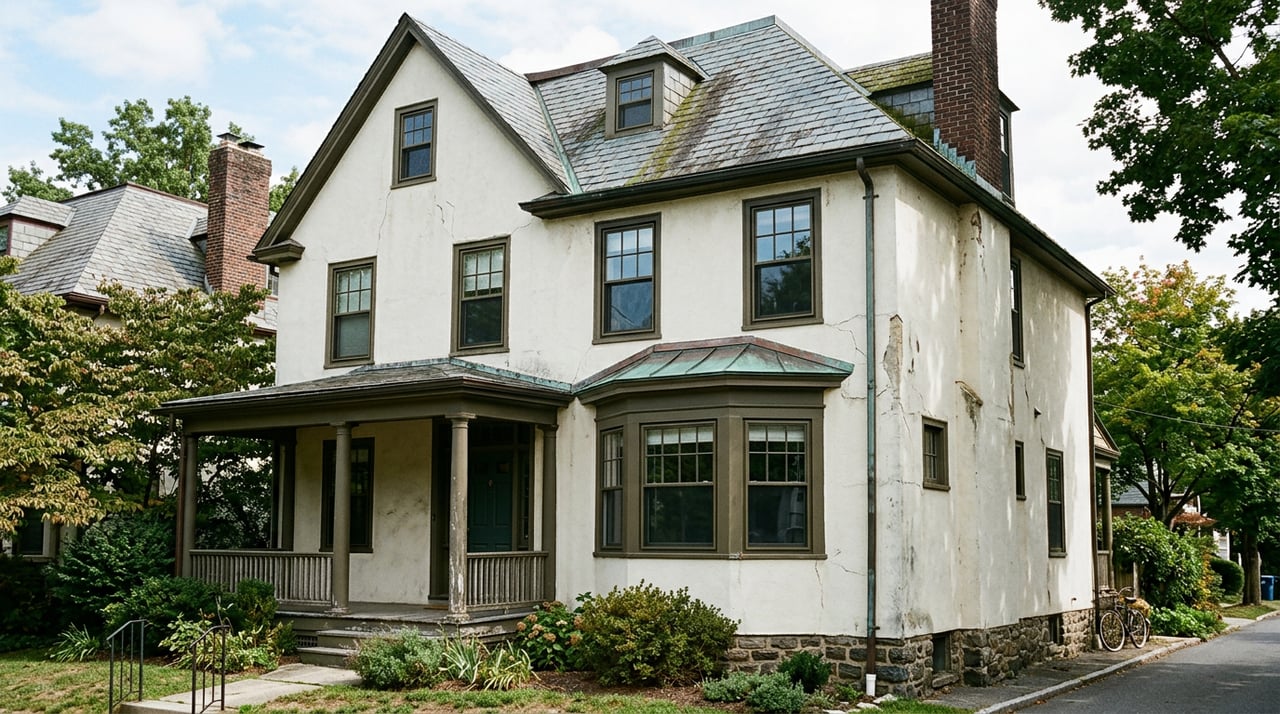
Buyers touring a stone-front colonial or a stucco twin in Narberth tend to worry about the wrong things on inspection day. They brace for a bowed foundation wall, a roof that needs replacing, maybe a furnace on its last winter. What actually derails a closing date in this borough is quieter than any of that: a coil of cloth-wrapped copper wire sitting in the attic, wound around porcelain knobs, that the seller assumed had been disconnected decades ago.
Narberth's housing stock runs mostly 1890s through the 1930s, Victorian and craftsman construction that predates grounded electrical circuits entirely. Knob-and-tube wiring was the standard method through the early 1940s, and it shows up in Narberth attics and basements as single wires strung through small white porcelain insulators, visible the moment an inspector pulls back the blown insulation. The wiring itself isn't automatically dangerous. It just was never built for a house running a modern HVAC system, a dishwasher, and three phone chargers at once.
The Real Deadline Isn't the Inspection. It's the Insurance Binder
Here's where the timing gets dangerous for buyers who assume a clean inspection means a clean path to closing. A home inspector flags knob-and-tube and moves on. It's the homeowners insurance carrier who decides what happens next, and many Pennsylvania insurers will not write a new policy, or renew an existing one, on a house with active knob-and-tube in the walls. Some decline outright. Others will insure the property but only after the buyer produces one of three things: a licensed electrician's letter confirming the visible wiring is in good condition and specifying exactly where it remains active, a report stating that all knob-and-tube has been de-energized and abandoned in place, or a full electrical evaluation covering the panel, service size, and any modifications made since the original install.
None of that happens during the standard inspection window. It happens later, when the buyer's lender asks for proof of insurance, sometimes just days before settlement. By then the inspection contingency has already expired, the mortgage rate is locked, and the buyer is scrambling to get an electrician out to a house they don't own yet.
One local inspector's report on a 1908 Narberth twin illustrates how this catches people off guard. The seller's disclosure listed the electrical as updated. The inspection found the third-floor circuit still carrying live current through knob-and-tube that had supposedly been retired years earlier. "Retired on paper" and "dead behind the plaster" are not always the same thing, and a disclosure form filled out from memory is not the same as an electrician tracing the actual circuit.
Why Narberth's Housing Stock Makes This More Than a Rare Find
This isn't a one-off finding. It's a pattern tied directly to how the borough was built. Narberth's twins share a party wall and, in many cases, a chimney flue with the house next door, which creates its own wrinkle when one side converts to gas heat and the other stays on oil. Original knob-and-tube runs are common enough in this housing stock that local inspectors treat it as a near-default assumption rather than a surprise, right alongside a handful of other issues that recur across the borough's older streets:
- Original clay sewer laterals, prone to root intrusion and, on the oldest blocks, gradual bellying that only a camera scope catches
- Stone or rubble foundations with lime mortar joints that break down after a century of freeze and thaw
- Lead paint on original trim, window sashes, and exterior siding
- Gas pipe conversions from earlier coal or oil systems, occasionally with venting that wasn't updated to match
- Slate or clay tile roofing nearing the end of its working life
Add to that Montgomery County's radon classification. The county sits in the EPA's highest radon risk tier, Zone 1, which is why a 48-hour radon test is standard practice here rather than an optional add-on, and why a mitigation system, when one is needed, typically runs $800 to $2,500 installed.
What These Findings Actually Cost
None of this needs to be alarming, but it does need to be priced into a decision. A full home rewire to remove knob-and-tube starts around $5,000 and scales up with square footage. A failed sewer lateral, once it actually collapses or bellies badly enough to require replacement, runs into five figures. Radon mitigation sits in the low thousands. A standard single-family inspection itself runs roughly $375 to $400 in this market, with condo inspections priced lower given the smaller scope of what's actually being examined.
| Common Narberth Finding | Why It Shows Up Here | Typical Cost If Addressed |
|---|---|---|
| Active knob-and-tube wiring | Homes built 1890s to 1930s, before grounded circuits existed | Full rewire starts around $5,000, scales with house size |
| Clay sewer laterals | Original clay pipe under many pre-1930 lots | Replacement runs into five figures if the line fails |
| Elevated radon | Montgomery County sits in EPA Zone 1, the highest risk tier | Mitigation system typically $800 to $2,500 |
| Stone foundation and lime mortar wear | Standard construction method for the era | Varies widely, often a maintenance line item rather than a closing condition |
A Pre-Offer Checklist
For buyers writing an offer, and sellers preparing to list, a few steps early in the process prevent the insurance surprise from ever reaching the closing table:
- Ask the listing agent directly whether the seller's disclosure addresses knob-and-tube status specifically, not just a general "updated electrical" note.
- If the inspection turns up any active knob-and-tube, call your insurance agent that same week, not after your due diligence period closes.
- Add a sewer scope to the standard inspection on any pre-1930 property. A working sewer today doesn't rule out a bellied section forming underground.
- Confirm your lender's exact deadline for proof of insurance and build a buffer into your timeline if either wiring or roofing issues surface.
- If you're selling and you already know some original wiring remains, get an electrician's letter in hand before the home goes live. It answers the insurer's question before a buyer's agent ever has to ask it.
What This Means If You're Comparing Homes
A twin with documented, fully modern wiring and a colonial with untouched 1920s knob-and-tube can carry similar list prices and very different real costs once insurance and financing enter the picture. The difference doesn't always show up in the listing photos or even the square footage. It shows up in how quickly a buyer can get a policy bound and a loan cleared to close, which is exactly the kind of detail that a purely price-per-square-foot comparison misses.
This is the part of a transaction where finance-informed negotiation actually earns its keep. Reading an inspection report is one skill. Knowing which findings will stall a mortgage underwriter or an insurance carrier, and getting ahead of them before they become a closing-week emergency, is a different one. Whether you're evaluating an offer on one of Narberth's classic twins or getting a pre-1930 home ready to list, the Damon Michels Team can walk the inspection report with you line by line, flag what's routine versus what needs an electrician's letter before settlement, and keep your insurance, lending, and closing timelines moving together instead of colliding at the worst possible moment. Contact us when you're ready to talk through a specific address.
FAQ
Does every older Narberth home have active knob-and-tube wiring? No. Many have been fully rewired over the decades, sometimes room by room as owners renovated kitchens or added central air. The issue is that partial rewiring often isn't documented anywhere, so a seller's disclosure based on memory can miss a circuit that's still live in a third-floor bedroom or an unfinished attic.
Can I still get homeowners insurance if the inspection finds active knob-and-tube? Often yes, but usually with a condition attached, whether that's an electrician's letter, a full evaluation, or a requirement that the wiring be de-energized before the policy binds. Some carriers decline these properties altogether. Working with an insurance agent who already writes policies on older Main Line homes saves real time here.
Should I request a sewer scope even if the seller says the line has never backed up? Yes, particularly on any lot from before 1930. Clay laterals degrade gradually through root intrusion, and a line that drains fine today can already have a bellied section forming that won't show up until a camera runs the length of it.
This article is general information, not legal, tax or financial advice. Consult a qualified professional about your situation.